Saturday, October 23, 2010

Pictures from homestay - Soundougouba, Mali

The soccer field. Play the game "where's the goal post?"
Kadri!
My host family - my host dad, his first wife sitting down, and his second wife on the left.
My nyegen!
Daow. This is one of my host brothers. I hung out with him a lot and we chatted in French. He's at the University of Bamako studying pre-law and owns a store in a town nearby. When I asked him what he wanted to do getting his degree, he wasn't sure, but thought maybe he would either study more, keep working in the store, or work in the fields. His older brother has a degree in marketing and now owns a few hectacres of corn field.
Everything a Malian woman needs to pound millet, toh, and shea butter.
The girls eating dinner of toh and okra sauce.
This is my host dad's mother, Tieman (my host dad's father) Diarra's 1st wife. She hangs out under her gwa all day and takes care of the little girls. My room is in the back left of the picture.
Kadi is Fanta's daughter, in her terrrible twos, has been learning how to pound since she could walk, and probably the chubbiest baby in Mali. Fanta is 17 years old and her husband died while she was still pregnant with kadri.
My host dad's house is the white one and his wives' house is on the right. They aren't so much houses as they are sleeping rooms since everyone just spends time outside.
The water pump
Normally breakfast wasn't this good, but I had to take a picture of this one where Ryan brought over an egg sandwich with fries and oranges. I also included a full pack of 10 gazelle tea packages, the best tea in Mali according to my host family.
What I see outside my window. Including my 5:00am alarm clock, the family donkey...
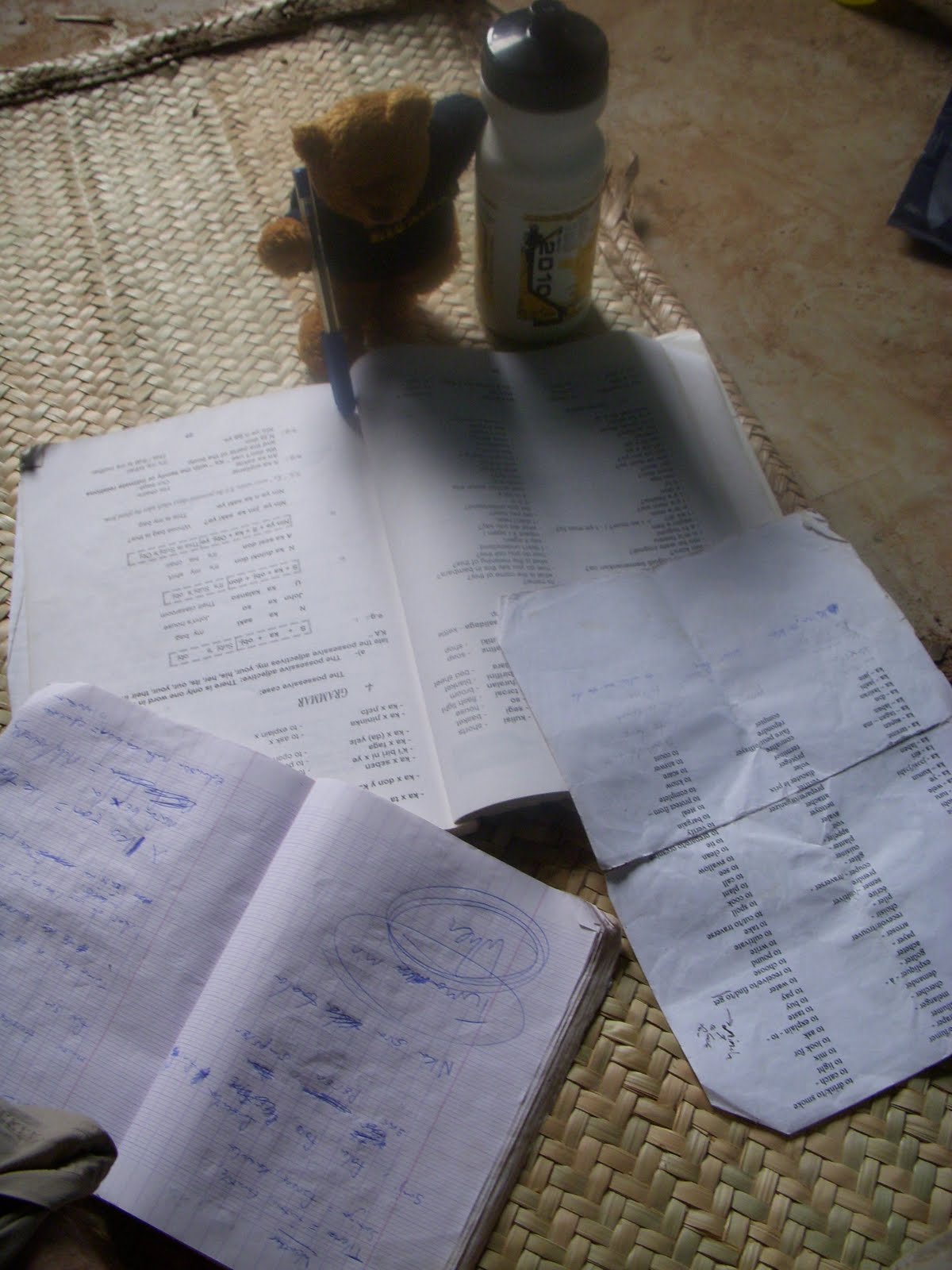
The Michigan bear studying Bambara with his water bottle
My bed under the mosquito net.
Baby goat
The kids of Soundougouba during the full moon.
This is what I like to call the full moon rabbit costume. The kids get underneath and dance around going from concession to concession getting small change and snacks. Kate (the other volunteer in the picture), and I got under the rabbit at one point and danced around a bit.

Rocks by Soundougouba

Sunday, October 17, 2010

School!

School started!!!! I was so excited! I was asking every kid I met if they were going to school. I have found out a few things that is extremely disheartening. In Nioro, only 16% of all students who took the DF, which is the high school entrance exam, actually passed. This means that 8th grade classes are going to be even more packed than usual and for a large number of these students, it was their second time attempting to get into high school, which means that unless they go to private schools they are officially out of the Malian school system and have to find jobs which are already almost non-existent. When I found this out, I had my first moment of shock and realization that I might really not be able to do anything substantial. I couldn't really believe that it could be so low. I heard this during a meeting with all the school directors and the CAP and had to mentally remind myself that this is why I was here and that if I joined the people that thought it was hopeless and wouldn't bother adding the drop of water, then the glass would never become full anyways. Unfortunately, it's so hot here, sometimes that drop of water just evaporates haha. It was rough to hear, but it just means that I have a lot to do, and I've already started by creating a sort of tutoring session with students in my neighborhood. One of the toughest parts of this was that I'm trying to gain their respect and show them how to properly behave when they're in my house so that they can learn effectively and efficiently. I've only been doing this for about 2 weeks, but there are some kids that are really motivated. Eventually I'm hoping to turn this over to actual teachers who will take on the role of supervising the students while the older students help the younger ones. This will allow a precedent where students come to reinforce their knowledge, help each other out and study outside of class. The thing is, is that the children here really are motivated. For the most part they want to learn. They are tired of their parents telling them they are good for nothing. They see education as a means to get out of their town and move on to a better life, and they see that reading and learning is fun. I remember when I first learned to read all I wanted to do was devour books. I also remember when my brother first learned how to read, and I hadn't yet, I was confused and frustrated with the fact that he was being boring and reading all the time instead of playing with me.
The teaching/tutoring has been entertaining and frustrating. From what I've been able to see, the way they learn is almost entirely about memorizing lines and phrases, without necessarily creating an association to what it means. Because there are 70+ students per class, the teacher can't focus on a single student or the meaning behind what they are instructing. So one thing I've been doing is asking "why" to everything I do. Also, my parents sent me some Sudoku books, so I've been using the easy puzzles to get them to think using logic and reason. This requires a lot of patience and having to explain things over and over again. I'm not sure how to explain that they don't have analytical skills or association from one subject to another, but I see it most often with regards to math problems and when I teach them English. Interestingly, even though their learning method has always been memorization, they have an extremely low retention rate. I think that might be because of the lack of reasoning. They don't seem to understand why things are the way they are. They just accept them. Similar to the way they accept things in the Islamic religion without understanding the true purpose behind it. There have been some fun parts, such as when, in the middle of talking, one of the students jumped up and said "You know what we want to do!! We want to sing the Malian national anthem!" This was when we were working on the pronunciation of "How are you?". So for the next 2 minutes they stood up with their hands over their hearts and sung the Malian national anthem. Very entertaining until they told me to sing the American national anthem.
Before school started I went to a few of the schools to find out what kind of issues they were having. For one, it was several things. This is in the very religious district so parents have very little interest in formal education and believe that it's just colonial brainwashing that will drive them away from a strict Islamic lifestyle. So the parents are not very involved in getting their kids to school and many of them are against their daughters going to school. The school director has been talking about how parents aren't motivated and don't really care and stated this as one of his major concerns and frustrations. Without parent involvement, kids don't go to school and the school board is financially static. Another problem was that the school wasn't surrounded by a wall. Now cloistering a school may not seem like a pressing concern, and I personally didn't think much about it. But, when you are trying to plant trees because the students don't have any shade when they go outside in 100+ degree weather and the saplings keep getting eaten by roaming sheep, goats, and donkeys, and also when motos fly through the school yard because they think it saves them time, and when the kids get distracted by things outside, surrounding the school becomes a relevant concern. The other thing is that there isn't a good water source near the school. The only source is a pump (which isn't very sanitary because it hasn't been treated) about 400ft away. While I was there I joined in with the kids to help surround the school with rocks we found in the area so that the motos wouldn't come in. I expect that if I went back today they would already be gone, or the drivers decided it wouldn't actually damage their bikes and now drive over the rocks. Fortunately the school director is very good and very motivated. He doesn't seem to give up and tries to plant trees annually, tries to get parents involved, and has a good relationship with his teachers.

With regards to informal education, this has been a challenge to watch and not react. Malian families are big. According to Shariah law, men can marry up to 4 women. Any children that your brothers or sisters have you refer to as your children and your friend's children are basically your children. Anybody is allowed to reprimand any child that they see doing something wrong. This can be anything from a verbal scolding to beating the child with stick. As a result of such big families, the children take care of themselves. They do whatever the parents tell them to do, they eat what the parents give them, but when it comes to general day to day things, the kids help each other out. Parents don't have time to explain things and properly discipline their children for something they've done wrong. So they resort to the quickest way of punishment they can think of, which is to either tell the kid he/she is stupid and good for nothing, or hit them and scream at them. Watching this is not fun. But of course I can't tell a parent that they are wrong and ruining their child or that this will mean their child will beat their children in the future. There are several reasons why I can't do this: 1) My language isn't good enough, 2) if I did I would be the crazy Toubab who thinks that he knows better would therefore alienate myself from the community, 3) they were beaten by their parents and this is all they know, plus they are angry with the fact that they were beaten before and take it out on their kids, and 4) "it isn't bad to beat your kid, it's necessary because things here aren't the way they are over there and just talking to these kids isn't enough, they only understand if they are hurt, and anyways, this will make them fear you and respect you so that they won't do it again" - Local Malian. Unfortunately for this local Malian, I had just been told by his son a few days before that one time he was hit by his dad and then immediately did the same thing a few hours later just out of spite.
I remember, before I left I had a conversation with my good friend, Denise Rowe about disciplining children. Denise was a Child Behavioral Psychology major a the University of Michigan. We had a mutual friend who said that as a kid, her parents had a track outside their house and the way they punished her was that they would make her either run or walk laps. I thought it was a pretty cool idea because it was a good way for the children to stay active and use up that pent up angry energy to vent. Even walking allowed the child to think about what had happened. She disagreed and said that any punishment had a backlash and consequences contrary to the intentions of the parents. She said instead, the parents should get their children to open up by talking to them, getting them to explain their feelings and really understand why it was that what they did was bad. She said that making them exercise as punishment would actually make them resent exercise and dislike it in the end. I've thought a lot about this and I think I agree, especially with the style of informal education I've seen here. I have never been against physical abuse towards kids, but this has really shown me that it is almost completely ineffective and only causes a perpetual cycle of pain, anger and frustration. More about informal education later.

One things that I found out, which I will expand on in the future, is that when a conservative culture such as Nioro crumbles, it collapses completely in an extremely shocking way.

For Whom the Imam Calls

Ramadan started while I was in Nioro during site visit. This means that all Muslims must fast, so they can’t eat, drink water, smoke, or drink tea which is really funny because this might be the hardest part for them. Not drinking tea makes them jittery and some were irritated during the first week or two before they got used to not being constantly caffeinated. Other than eating breakfast at 4 in the morning before the sun goes up, life goes on as usual. The women still pound millet, corn or shea, do laundry, cook, fetch water, and take care of the kids all day. The men still go out to the fields, and as difficult as I thought it might be, they sit around and take naps even more than before (I think a result of not drinking tea). At around 6:30 or 7:00pm, the Imams on the radio begin to announce the end of the fast. The women break out the monni (millet cooked in water with lime juice and sugar). I think that this is to cut the thirst, because with enough lime juice it is refreshing. A few times they had a ginger juice which was good, but rather spicy.

After the bucket bath, my host father dresses in a nice full length boubou and sits down in his new bamboo recliner. He listens carefully to the radio and although it doesn’t show, I know his stomach is pounding, his head is light from dehydration, and I can almost visualize his thumb striking the lighter while his fingers itch for the feel of a cigarette to rest lightly between them. The air explodes with the sound of prayer as the sun dips slightly behind the horizon. Every concession has a radio tuned in to the same program, and the mosque’s sound system begins the chants that proceed the break of fast. After ensuring that the men have everything they need, the women can finally sit down for a few minutes. The children are eating, and the food is ready, they only have to wait for my host dad to grunt or say a barely intelligible word for them to get the bowl and set it in front of his chair. After going to mosque one more time, the family will stay up late, sometimes until 2:00am before going to bed. The whole time they eat corn on the cob, monni, and whatever has been prepared. Then they wake up at 4:30am to eat before the sun rises again.

The month of fasting ended when I got back to Nioro as a volunteer. It was pretty fun because everyone enjoyed their day off by killing a sheep, roasting it and spent the whole day eating and drinking tea. The kids also go around and bless everyone wishing them a good year for them and their family and in exchange you give them a little gift. This is the only time I have given a gift, but I still avoided giving money and only gave them little things I had brought specifically to give as gifts such as pencils or stickers (they really didn't like the stickers and found them boring). Ramadan is really an awesome month. It really helps the Muslim community understand what it's like for a large portion of the world. Many people do not have the luxury of eating all day or even eating 3 full meals a day. So for a month the Islamic community joins these people in fasting and understanding what it's really like not to have food or water in their stomachs for a whole day. Of course some people cheat and just about everybody has a day or two where they are very irritable, but for them it's spiritual and brings them closer to their families and every human being in their community. They create the support network of understanding that nobody else is eating or drinking and help eat other through the day.

Kayes

In Kayes for Language In-Service Training. This means that I come in to my regional capital for a week to work with one of the Peace Corps language trainers and get to take a break with some other PCV's. Besides this, I'm technically not allowed to leave my site until December. But I'm taking advantage of it to post here and update myself on world news/Michigan football/respond to e-mails.

I'll be posting 2 or 3 blog posts to cover my absence and not to make one single post too long. This will cover different topics individually although with my line of thinking they'll probably get intertwined, but I'll try to keep things separate and organized.

Tuesday, August 17, 2010

Dependency

I split my post into 2 so that it was more manageable. This is something I've been meaning to talk about, but don't forget about the previous, more day to day post I made just seconds before.

I am so frustrated with the degree of dependency that this culture has! Everything has been given to them by NGOs, government aid, and people coming to “help out”. Not only this, but this is compounded by their colonization. They have become so dependent on foreign and external aid, that they are almost incapable of helping themselves. Money is necessary to help people, but unless something remains sustainable by the local community, it basically becomes pointless once said organization or people leave. Every time we go to an organization that is working in the education sector, they are always talking about how they are getting funding from external sources whether it’s an NGO in Italy, France, the US, they think that their solutions are based in financial support from outside Mali. I understand that Mali is one of the poorest countries in the world, and I’m not arguing that financial aid isn’t necessary or doesn’t help, but when a country has become so saturated with external funding that their very first solution to a local problem is to try to find a partner NGO in another country that can fund any project, they cannot be considered an independent country. Mali may have gained it’s independence 50 years ago, but it is currently just as dependent, if not more dependent on external powers than it was under French colonization. I asked someone at Soundougouba what he would do to try to make a difference in Mali, and he said that his dream is create an orphanage program that would take children off the streets of Bamako and have them work. When I asked him who would provide the infrastructure and food for these orphans, he talked about an NGO in Italy. If I could have expressed myself in Bambara, I probably would have exploded about how he’s perpetuating a system that is keeping Mali in a state of submission and dependency. Unfortunately, or maybe fortunately, I don’t, so I had to calmly and slowly explain a simplified version of my feelings in French so that he would understand. This mentality of being given things can be directly shown in the fact that the kids sit there and demand gifts.
This is what I like about the Peace Corps system. The volunteers are placed in a country where they are given language lessons, taught to “Teach people to fish for themselves, not give them fish” and live among the people they are helping while receiving a stipend that is the average for the country. All of this done with the intention of creating a sustainable organization or program that the locals have expressed desire to initiate and continue. I’m not saying it’s a perfect system, but it’s much better than religious missions or NGOs coming in for a few months, building a well, not teaching the locals how to fix the well once it breaks, or throwing money at a problem where half of it disappears in the maze of corruption. (I know NGOs do a lot of good, and so do missions, but when the sustainability doesn’t exist, then the solution is temporary.) If money and external aid could help a country like Mali develop without the locals being invested and helping themselves, the billions of dollars and resources that have been thrown at the country in the past 50 years would have made Mali one of the top developed countries in the world. But as it is, there is still a huge food security problem, not even half the population can read and write, and sanitation/health issues are a major concern.
(I'd like to know people's opinions on these things.)

Also, when I bring up cultural issues. Please do not think that I dislike the culture or that I'm not integrating. I'm just stating differences that to me are difficult to relate to. I've always felt that I come from a rich cultural background and that I've had friends from all over the world, so I have never had trouble relating to people. So when I come to a country (and this also depends on the region of Mali) that does not have a strong food culture (they don't even like their "national" food: toh), there are almost no visuals besides henna and fabric (part of this could be a result of the Islamic faith ensuring little representation of Mohammed and such), and no reading/writing, I have been a bit thrown off. I'm using this blog to explain how it is as bluntly as possible, which may make people think I am not enjoying myself or that I feel like I will be ineffective. I only write this because I haven't realized how blunt I've been until I started receiving e-mails and I want everyone to understand that what I say about the country here does not necessarily reflect how I interact with the people.

With that happy note, I hope you enjoyed my novel, and now I’m off to homestay. Give me a call if you want more in depth news about my site visit/travels around Mali.
Messages/e-mails are always really fun, even if it’s something like: Went to the movies today, saw X Movie. Actually that would be sweet, because I have no clue what movies are out right now. Or how sports are going.

Also, congratulations on getting your driver's license Isabelle!

I'll be back in 2 weeks.

Site Visit

First of all, there are a lot of things to talk about, so I’m going to try to keep the site information brief and tell a few stories instead. I know this blog is long, the next post I find to be the most important thing I have to say.
Fortunately, I got to take Peace Corps transport up to my site, which meant that I got to take extra luggage up without having to put it on public transportation, which I’ll have to do when I fully install. My site buddy (a previous volunteer who knows the area) names Alyssa Mouton was awesome and showed me around the areas that she knew, but since she had only been to my site to visit a fellow PCV (Peace Corps Volunteer), she only knew the market area where the previous volunteer lived. However, it was extremely relieving how comfortable she felt as a woman in a large city, and also very comforting to have her there when my housing situation went awry. Basically, my housing was a complete fiasco. Just a quick note: Peace Corps is excellent about finding people housing and counterparts to work with… I just fell through the cracks. Anyways, my house wasn’t ready (I was about to stay there for 5 days) because it wasn’t clean, not up to Peace Corps regulations, and occupied…. So, they found me another place while they told the entire family to move out, which, apparently they hadn’t paid rent for over a year, but I didn’t come here to displace families.
Long story short, my 5 days at my future 2 year site was rather chaotic but is currently being taken care of and I will have a place to live that is secure and up to Peace Corps regulations within the next 3 weeks which is when I swear in, become an official volunteer, and then move to my site for the next 2 years.
Ok, so I know that details are warranted. My first thing is that my site is pretty cool. I understand that I might have said, and will say things that make it sound negative, but there are many things that factor into that appearance through words. First of all, I expected a small village. All the programs I had considered or thought about were around this thought. I was chosen for my site for very legitimate reasons, I understand and agree with them. I am looking forward to living there and I plan on doing the best I can to improve their education system among other things. First of all, the site is not pretty. This is not necessarily a bad thing. It just isn’t attractive. The land in incredibly flat, very sandy, shrubs thrive (at least in the rainy season), very little grass, and some trees. There is river that goes through the Northern part of town, but we’re in the rainy season… and it’s still barely a creek (and creek is the wrong word, because that makes it sound cute, and green, but it’s just sand). The streets aren’t paved, there is a big market, and very few multi-story buildings. Essentially, imagine Ann Arbor without the greenery, all the houses are made of mud and not more than 1 story, and the streets are all mud except for main street. So it feels like a very large, slightly disorganized sprawl. I will be living in a private walled concession with my own house of 4 rooms (one of which is a bathroom), a separated kitchen, and a separated single room. I have 2 trees within the walls of my compound, and some dirt where I plan on making a garden with lots of vegetables.
City life is very different from my small town of Soundougouba. First of all, I have electricity and running water (internet is supposedly at the new high school, but since school isn’t in session right now, I can’t really use it). I don’t have to greet everyone, but I am the really weird white guy, so I say hi to as many people as possible in order to make friends and establish more security. I know I said last time that my Bambara might be useless. This was much to strong, and I understood that when I wrote it. I was just frustrated at the time, but although French is the “official” language, Bambara is the “national” language, and even if they don’t speak the language, they understand what I’m saying. My favorite part about this city is actually the fact that there aren’t only Bambara people here. There are Sonninke, Bambara, Malenke, Fulani, Moors, and Mauritians. All have their own features, language, and dress that I’m starting to learn to recognize. Definitely excited to start dressing like a Moor, because their fabric designs are awesome! Anyways, all kinds of different cultures coming together and once I get language down, I’m going to have a field day. I was extremely happy to find out that I can understand a good deal of Bambara as long as I know the context. If I know where the person is going with their story or what they are trying to tell me (which when I meet people it’s almost always the same 4 or 5 questions), I can respond appropriately. And many people speak French and they all think I’m French. I actually made a point of when people spoke to me and I had the ability to speak in Bambara, I would. This way, they would understand that I understood them and was willing to meet them halfway/speak their language and not only were they more receptive to that, but they were more friendly. Of course, usually this led to me saying, I only speak a little Bambara, and as the conversation progressed, we would switch to a mixture of Bambara and French. So I answer anything I can in Bambara, and use French as a crutch, which hopefully won’t stunt my Bambara. Anyways, as I said, there are an incredible number of cultures here, and so my homologue told me that my name, Tieman Diarra, was too obviously from the Segou region, and that I would have to get a new name. So I told him to start listing first names. He couldn’t think of enough, so I decided that I would go with Shek. This is a much more Muslim name and since the city is more conservative and Muslim, I thought it would be appropriate. Most of the people I speak to know me as Tieman, but now I’m using both names.
But!!!!! Then I was hit with an amazing idea. Unfortunately, I haven’t been able to implement it because I thought of this the last day and didn’t get to introduce myself enough. My new name, it sounds very Arabic, I know, but bear with me, it’s basically perfect. My new name, is now Saiph Diarra. This only means something to a few people back home, but it’s one of the best names ever regardless of what people working at the planetarium might think, it’s an awesome name that means “The Sword”. I mean, thinking about it, being a Peace Corps volunteer, and the fact that Diarras are known as lions, the most appropriate name would be Mebsuta (the outstretched paw), but I’m a big fan of Saiph. Plus, it’s a sweet star that is part of the Orion constellation. So, we’ll see, I’m not 100% sure I’ll keep it because so many people know me as Tieman now, but whatever, it’s all good.
Also, you know how I spoke about joking cousins? Well, my favorite is the Traore – Diarra relationship. Maybe it’s just because it was the first joking cousin I learned about, but they seem to have an exceptional joking attitude towards one another. My favorite joke, which is a huge hit among Malians, is that Diarra (known as the lion), is a walaba (very strong lion), and that Traore is a jakuma fitini (very small cat). This is an awesome way to gain someone’s friendship and one that I exploit as often as possible.

Please excuse the typos, I wrote this rather late last night.

Thursday, August 5, 2010

Soundougouba Round 2

So guess what!!
I just found out where I'll be spending the next 2 years of my life! And it turns out, that it's in one of the hottest, if not, IS, the hottest place on earth! I'm off to the Kaye region of Mali! Unfortunately, I can't blog about where I'm actually going to be due to Peace Corps regulations, but I am willing to tell people individually, actually, many of you will probably already know by the time you read this, but I don't have everyone's e-mail groups, so please request it from me if you are really curious. The crazy thing, is by public transportation, the closest other volunteer will be about a 6 hour bus ride. It's not that I'm out in the middle of nowhere, it's just that I am that far removed from other sites. I have been told that there will be 2 health volunteers somewhere on the way from Bamako to my site, but probably not any closer to 3 hours away. Pictures of me riding a camel cannot be too far in the future, also, I need good camel names just in case the opportunity arises where I either need to name a camel or buy one, so feel free to let me know. Another thing, I spoke to my homologue today (this is the guy that is assigned to be my initial contact when I get to site, so he's basically like a host dad but he doesn't take care of me, just make sure I know someone there), and he speaks English which is nice, but I really want to speak to him in French or Bambara so that I can practice. But he told me that I will most likely have to learn Sonninke or Fulani... which means that the past 5 weeks of Bambara lessons were almost useless in the sense that I will have to restart. I mean, they weren't useless because for the most part people will have a working comprehension of Bambara and I'll be able to use my Bambara when I'm in other parts of Mali, but I'm still not too happy about having to start all over again.
Also, I'm kind of stealing this idea from another trainee. But, just a challenge to those who are reading this. Throughout your day, try to focus on and remember the number of different things you read. This could literally be anything from this post, a newspaper article, your phone settings, the ingredients on the back of a cereal box, street signs, books, etc... I had mentioned in my previous post that the education system in Mali is pretty bad and that the number of literate/educated people is very low. To give you an idea, in the village I live in called Soundougouba, on average, I read about 3 things that are not either my book, my notes/Peace Corps papers. One of these, is the name of my host dad which is written upside down on the inside of my screen door for when it was delivered to the family, another is a sign that says "Attention!" to warn about the speed bump as you come into the village from the north (I read this on on my way back to school, so it should count as 2), and the name of my host dad again written on the donkey cart which is in my concession. Occasionally I pass or notice the faded lettering indicating the name of the road where my host family lives. Other than this, I read my bambara notes, my phone every once in a while, my book(s), the names of the artists on my ipod, and Peace Corps notes on NGOs in Mali. Oh! and when I had a bout of diahrrea, I read the package of the pepto bismal pills they gave us from our medical kit, that was very exciting.

Rain is probably my favorite thing ever right now. Whenever it rains, I can finally cool down, and it feels good. I did find a great spot on the rocks overlooking Soundougouba, that is well shaded. On my way to this spot, I startled an owl from it's tree. Very big white spotted owl, not sure what species but it was gorgeous and seeing it fly was pretty awesome. For the most part Mali is very flat. The terrain is very rough, with almost no grass and mostly rocks and sand. Shrubs and certain trees have no problem growing, but it's just a tough place. I don't mean this in a negative way, I was just asked about the terrain and there isn't any other way to describe it. Near Soundougouba, and apparently in other areas near Bamako, there are there rock outcroppings formed by large boulders. Not sure how to describe these because they aren't gradual slopes, but rock suddenly jutting upwards. The rock is been shaped into boulders by the rain, so it makes for good for climbing.

Starting a short story/graphic novel with an artist from the UofM that will be titled "Negen Man".

Off to bed, I'll post more tomorrow.